Application: Inverse Design
Inverse design uses MolCraftDiffusion to generate molecules that satisfy a predefined objective rather than simply resembling the training data. Two common objective types are especially relevant:
Route |
Objective |
Mechanism |
|---|---|---|
Property-directed |
Target a scalar property (energy, excitation, score) |
CFG, gradient guidance, or hybrid |
Geometry-directed |
Target a 3D arrangement (distance, angle, spatial motif) |
Structure-guided generation + descriptor filtering |
1. Target Property Inverse Design
Use this route when you want to bias generation towards a numerical target such as an energy score, excitation-related objective, or another learned molecular property.
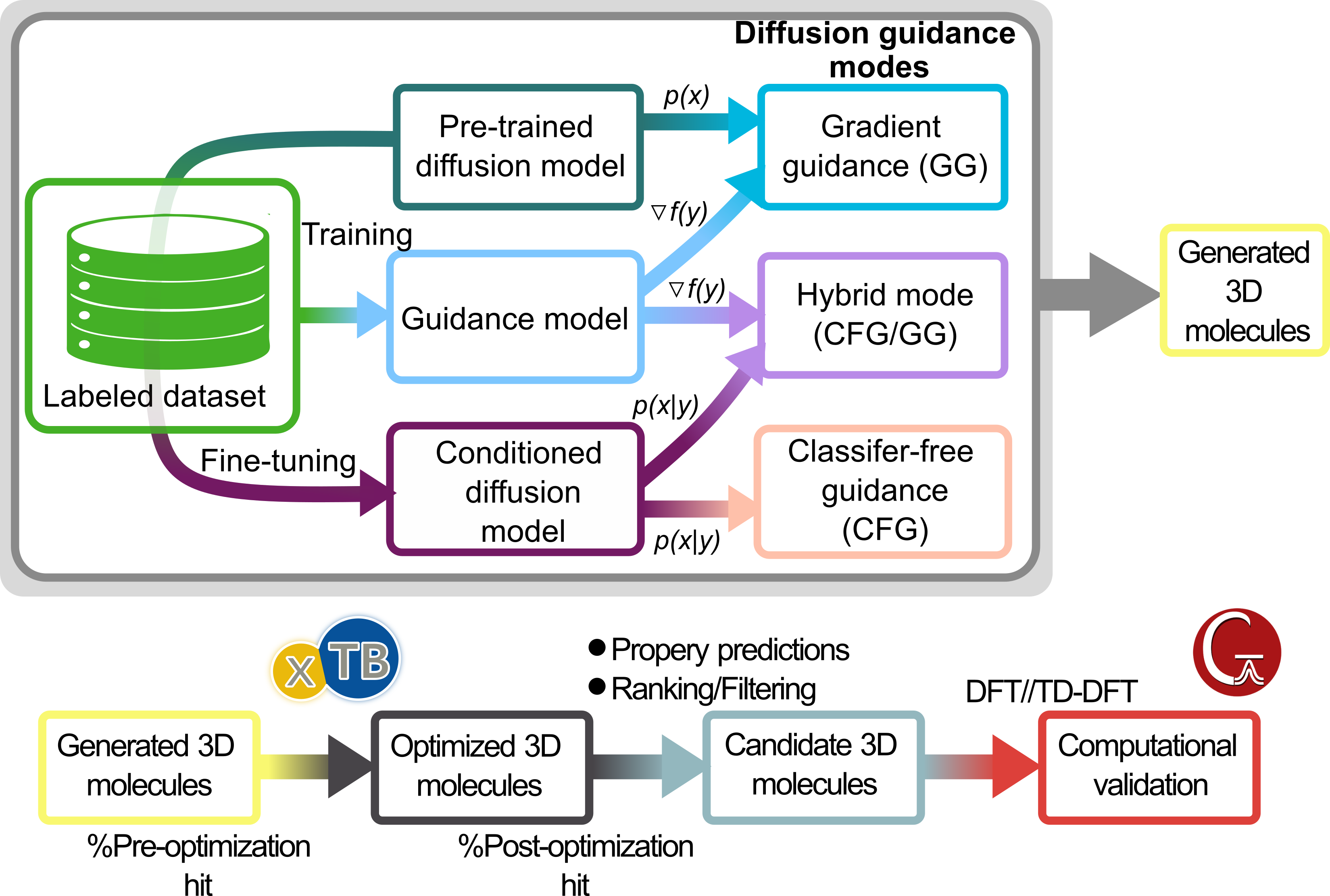
Conceptual view: the diffusion model is combined with guidance models so generation is biased towards molecules with the desired target profile, followed by ranking and computational validation.
Concept
The model is no longer asked to generate molecules that are only plausible. It is asked to generate molecules that are plausible and biased towards a desired property target.
Note
This is the right framing when your question is:
Can I shift generation towards a target electronic or physicochemical regime?
Can I enrich the output in molecules with better scores?
Can I search for hits without manually enumerating structures?
MolCraftDiffusion supports this through classifier-free guidance (CFG), gradient guidance (GG), and hybrid guidance.
Where to Go Next
See also
Starting templates:
Config |
Guidance mode |
|---|---|
|
Classifier-free guidance |
|
Gradient guidance |
|
Hybrid CFG + GG |
Application scripts (singlet-fission use case):
scripts/applications/singlet_fission/extract_gen_hit.pyscripts/applications/singlet_fission/extract_g16_output.py
2. Target Geometry Inverse Design
Use this route when the design objective is primarily structural — for example a target distance, angle, or spatial arrangement between functional groups.
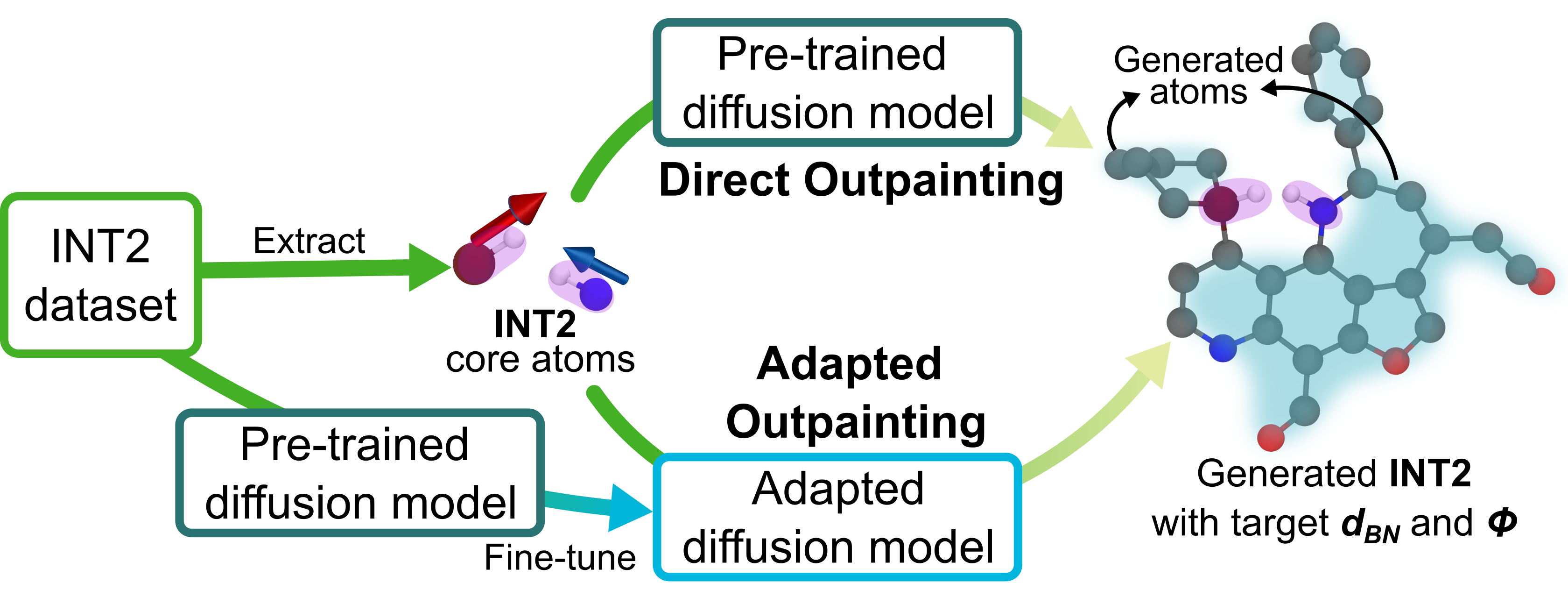
Conceptual view: a core motif is preserved while structure-guided generation builds candidates that satisfy a target 3D arrangement.
Concept
In this setting, the target is not just a scalar property. The target is a geometric arrangement that the generated molecule should realise in 3D space.
Note
This is the right framing when your question is:
Can I generate molecules that place key atoms at the right distance or angle?
Can I keep a reactive core while varying the surrounding structure?
Can I enrich for candidates that satisfy a geometry-driven design hypothesis?
This typically combines structure-guided generation with descriptor-based filtering and downstream evaluation.
Where to Go Next
See also
Application scripts (IFLP geometry-targeting use case):
scripts/applications/iflp_geom_target/compute_iflp_geom_desc.pyscripts/applications/iflp_geom_target/process_int2_database.py
3. General Advice
Important
Keep these principles in mind for any inverse design campaign:
Start permissive, tighten later. Use relaxed generation settings first and apply stricter selection criteria once you see the output distribution.
Separate validity from objective satisfaction. High target scores alone are not enough — confirm the molecule is chemically reasonable.
Re-rank with external calculations. Physics- or chemistry-based checks (xTB, DFT) matter for any high-value campaign.
Treat guidance strength as a trade-off. Stronger guidance improves objective alignment but can reduce structural realism.